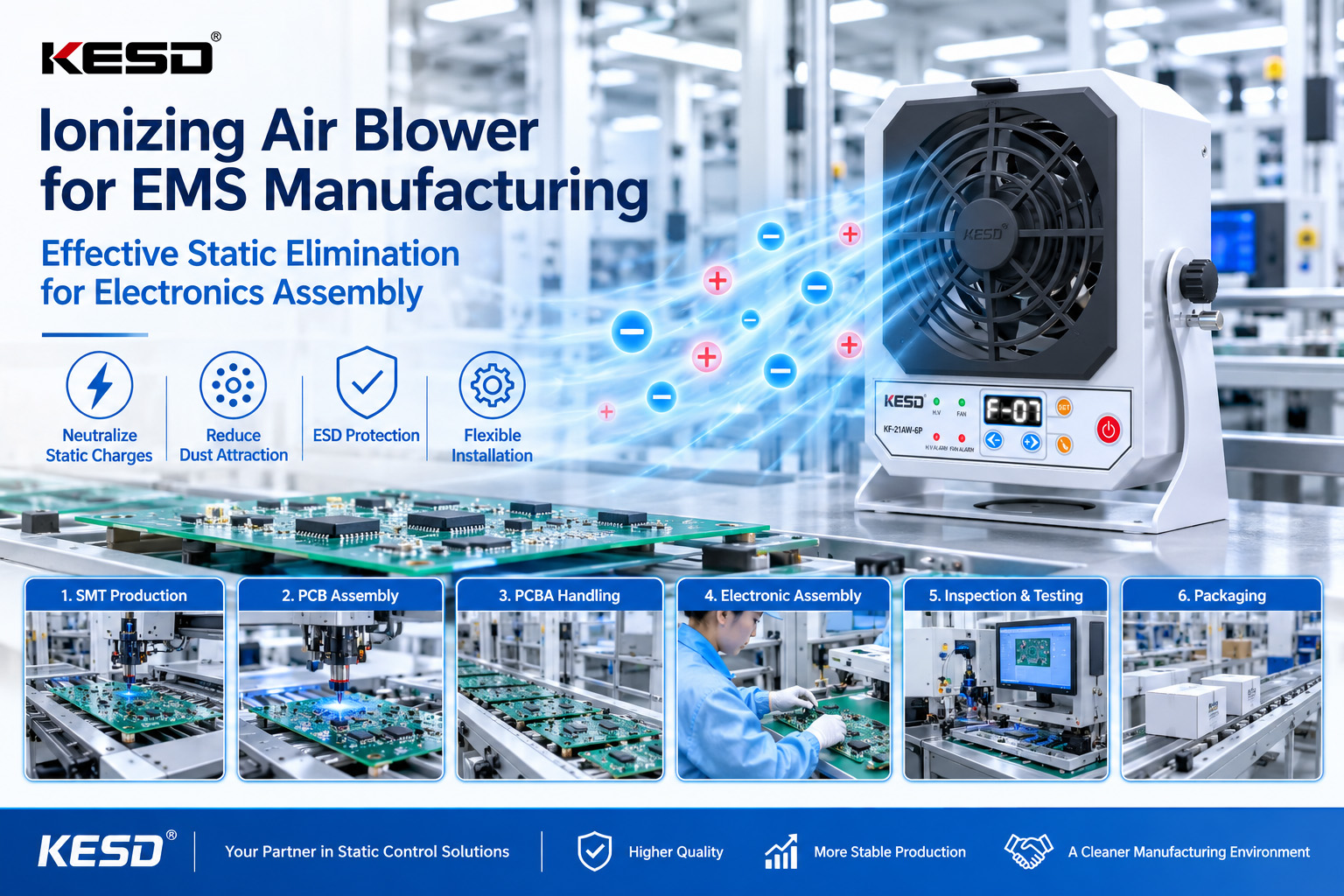


Electronic Manufacturing Services (EMS) providers manage a wide range of manufacturing operations, including SMT assembly, DIP insertion, PCBA production, electronic product assembly, functional testing, and packaging.
Throughout these processes, printed circuit boards (PCBs), electronic components, plastic housings, and insulating materials can accumulate electrostatic charges through friction, contact, separation, and material handling.
Uncontrolled static electricity may cause electrostatic discharge (ESD), attract airborne dust, and increase product quality risks, particularly when handling sensitive electronic components.
KESD Ionizing Air Blowers provide localized, non-contact static elimination for electronic manufacturing workstations and automated production equipment. By generating positive and negative ions and directing them toward charged surfaces, they help neutralize electrostatic charges and reduce electrostatic dust attraction.
With flexible installation and targeted ion delivery, KESD ionizing air blowers are suitable for static control applications in SMT production, PCBA handling, electronic assembly, inspection, and other EMS manufacturing processes.
EMS factories handle different electronic components, materials, and finished products throughout multiple production stages. Static electricity can create several challenges during manufacturing.
Sensitive electronic components, including integrated circuits (ICs), MOSFETs, sensors, and semiconductor devices, may be damaged by electrostatic discharge.
ESD events can result in immediate component failure or latent damage that affects long-term product reliability.
Charged PCBs, electronic components, and plastic housings can attract airborne particles.
Dust contamination may affect PCB cleanliness, connector contacts, optical components, and finished product appearance, increasing cleaning and inspection requirements.
During manual assembly, operators frequently handle PCBs, electronic components, plastic enclosures, and insulating materials.
Friction and contact separation can generate electrostatic charges on products and nearby materials, increasing ESD and contamination risks.
Automated pick-and-place machines, component feeders, robotic handling systems, and inspection equipment involve repeated material movement and separation.
These operations may generate static charges on components, fixtures, and product surfaces, creating challenges for stable material handling.
Plastic enclosures, protective films, trays, and packaging materials can retain electrostatic charges.
Static attraction may cause dust accumulation, material adhesion, and handling difficulties during electronic product assembly and packaging.
For EMS manufacturers, localized static elimination is particularly important at workstations and equipment locations where static charges are repeatedly generated.
Electrostatic charges are commonly generated through contact and separation between different materials.
In EMS manufacturing, several operations can contribute to static buildup:
PCB Handling: Contact between PCBs, fixtures, conveyor belts, and handling equipment may generate electrostatic charges.
Component Feeding: Separation of carrier tapes, component trays, and insulating packaging materials can produce static electricity.
Manual Assembly: Operators, tools, plastic housings, and electronic components may accumulate charges during repeated handling.
Automated Pick-and-Place: High-speed movement and separation of materials can contribute to electrostatic charge generation.
Plastic Product Assembly: Friction between plastic components and assembly fixtures may cause persistent static buildup.
Inspection and Packaging: Protective films, trays, and packaging materials can generate electrostatic charges during removal and separation.
Low humidity and insulating materials may further contribute to charge retention.
To control these risks, EMS manufacturers should implement a comprehensive ESD control program that includes personnel grounding, appropriate ESD-safe materials, grounding systems, ionization equipment, and regular static monitoring.
KESD Ionizing Air Blowers are designed to provide localized static elimination for electronic manufacturing workstations and production equipment.
The ionizing air blower generates positive and negative ions and delivers them through an airflow toward the target surface. Ions of the opposite polarity help neutralize accumulated electrostatic charges without requiring direct contact with the product.
Compared with ionizing air bars designed for wider treatment areas along production lines, ionizing air blowers are particularly suitable for localized applications where static charges need to be neutralized at specific working positions.
Localized Static Elimination
Provides targeted ionized airflow for specific workstations, equipment areas, and electronic product handling positions.
Non-Contact Static Neutralization
Helps neutralize electrostatic charges on PCBs, electronic components, and plastic housings without direct physical contact.
Reduced Electrostatic Dust Attraction
Reduces electrostatic forces that attract airborne particles to charged product surfaces.
Flexible Installation
Can be positioned near manual assembly stations, automated equipment, inspection areas, and component handling points.
Adjustable Airflow Direction
Allows the ionized airflow to be directed toward specific static-sensitive areas according to workstation layout and application requirements.
Suitable for Different Manufacturing Processes
Can be evaluated for SMT, DIP, PCBA, electronic assembly, testing, and packaging applications.
Actual performance depends on the blower model, airflow, operating distance, ion balance, environmental conditions, and target static-control requirements.
During SMT production, PCBs move through solder paste printing, component placement, reflow soldering, and inspection operations.
Static charges may accumulate during PCB loading, unloading, and handling, potentially attracting dust and increasing ESD-related risks.
A KESD ionizing air blower can be installed near suitable PCB loading or unloading stations to deliver ionized airflow toward the board surface.
Application benefits:
Helps neutralize static charges on PCBs.
Reduces electrostatic dust attraction.
Provides localized static control at handling stations.
Supports cleaner PCB handling before subsequent processing.
DIP production involves inserting through-hole electronic components into PCBs through manual or automated operations.
Component trays, insulating fixtures, and plastic packaging materials may accumulate static charges during handling.
Installing a KESD ionizing air blower near a suitable component handling or insertion workstation helps neutralize static charges on exposed components and nearby insulating materials.
This provides an additional layer of static control during electronic assembly.
After SMT and DIP assembly, populated PCBs undergo inspection, testing, and transfer between production stations.
Sensitive electronic components mounted on PCBs may be vulnerable to electrostatic discharge.
A KESD ionizing air blower installed at an appropriate inspection or handling station can deliver ionized airflow toward the target area, helping neutralize static charges accumulated on suitable surfaces.
This supports static control during PCBA inspection and transfer operations.
Manual assembly stations involve frequent contact between operators, tools, plastic housings, and electronic components.
Static electricity may accumulate on insulating materials and product surfaces during assembly.
A KESD ionizing air blower positioned near the workstation can provide localized ionization for static-sensitive working areas.
Typical applications include:
Electronic control board assembly.
Electrical connector assembly.
Sensor and module assembly.
Small electronic product manufacturing.
Plastic component installation.
Plastic housings and enclosures are widely used in electronic products.
Friction between plastic components, assembly fixtures, and handling materials can generate electrostatic charges, causing dust attraction and surface contamination.
A KESD ionizing air blower can be installed near the plastic housing handling or assembly station to neutralize static charges and reduce electrostatic dust attraction.
This is particularly useful for products with visible plastic surfaces and cleanliness requirements.
Electronic products may undergo functional testing, electrical inspection, and visual quality checks before final assembly or shipment.
Static charges on product surfaces and nearby insulating materials can create additional ESD and contamination concerns.
KESD ionizing air blowers can be integrated into suitable atmospheric inspection and handling areas to help control static charges before or after testing.
During packaging, plastic films, protective bags, trays, and cushioning materials frequently contact and separate from electronic products.
These materials may accumulate electrostatic charges, attracting dust or causing packaging materials to cling together.
A KESD ionizing air blower can be installed near suitable manual packaging stations or localized packaging equipment to provide targeted static elimination.
For wide packaging conveyors and continuous material processing, an ionizing air bar may be a more suitable option.
KESD provides industrial static elimination equipment for electronics manufacturing, automated production, and precision assembly applications.
Localized Ionization: Designed for targeted static elimination at individual workstations and equipment areas.
Non-Contact Operation: Helps neutralize electrostatic charges without physically contacting sensitive electronic products.
Flexible Installation: Suitable for different workstation layouts and automated equipment configurations.
Adjustable Airflow: Allows ionized airflow to be directed toward specific target surfaces.
Multiple Application Options: Can be evaluated for SMT, DIP, PCBA, manual assembly, inspection, and packaging operations.
Complete Static Elimination Product Range: KESD also offers ionizing air bars, ionizing air nozzles, static sensors, and ESD monitoring systems for different industrial requirements.
For wide-area static elimination along continuous production lines, KESD Ionizing Air Bars may be more appropriate. For highly localized applications requiring precise ion delivery, an ionizing air nozzle may also be considered.
KESD can recommend suitable equipment according to the actual static generation points and production requirements.
Choosing the right ionizing air blower requires understanding the application environment, target surface, and required static-control performance.
Consider the following factors:
Application Area: SMT workstation, DIP assembly, PCBA inspection, manual assembly, or packaging.
Target Object: PCB, electronic component, plastic housing, tray, or other insulating material.
Static Voltage: Initial static voltage and required residual voltage after ionization.
Operating Distance: Distance between the ionizing air blower and the target surface.
Airflow Requirements: Airflow direction and intensity should match the application without disturbing lightweight components or precision operations.
Installation Space: Available mounting position and workstation layout.
Environmental Conditions: Humidity, temperature, dust levels, and cleanroom requirements.
ESD Protection Requirements: The ionizer should complement, not replace, grounding and other ESD control measures.
Providing these details allows KESD to evaluate a suitable ionizing air blower for your manufacturing application.
Looking for an effective ionizing air blower for electronics manufacturing?
KESD provides localized static elimination solutions for EMS factories, including SMT production, DIP assembly, PCBA handling, manual electronic assembly, product inspection, and packaging.
Whether you need to control static electricity at an individual assembly workstation or integrate ionizing equipment into automated manufacturing systems, KESD can help evaluate the right solution.
To help us recommend a suitable ionizing air blower, please provide:
Application process and workstation details.
Target product or material dimensions.
Current static voltage or ESD-related problems.
Required installation distance.
Available mounting space.
Required airflow and operating conditions.
Cleanroom or ESD control requirements.
Contact KESD today to discuss your EMS manufacturing application and find a suitable ionizing air blower for reliable localized static elimination.
By continuing to use the site you agree to our privacy policy Terms and Conditions.