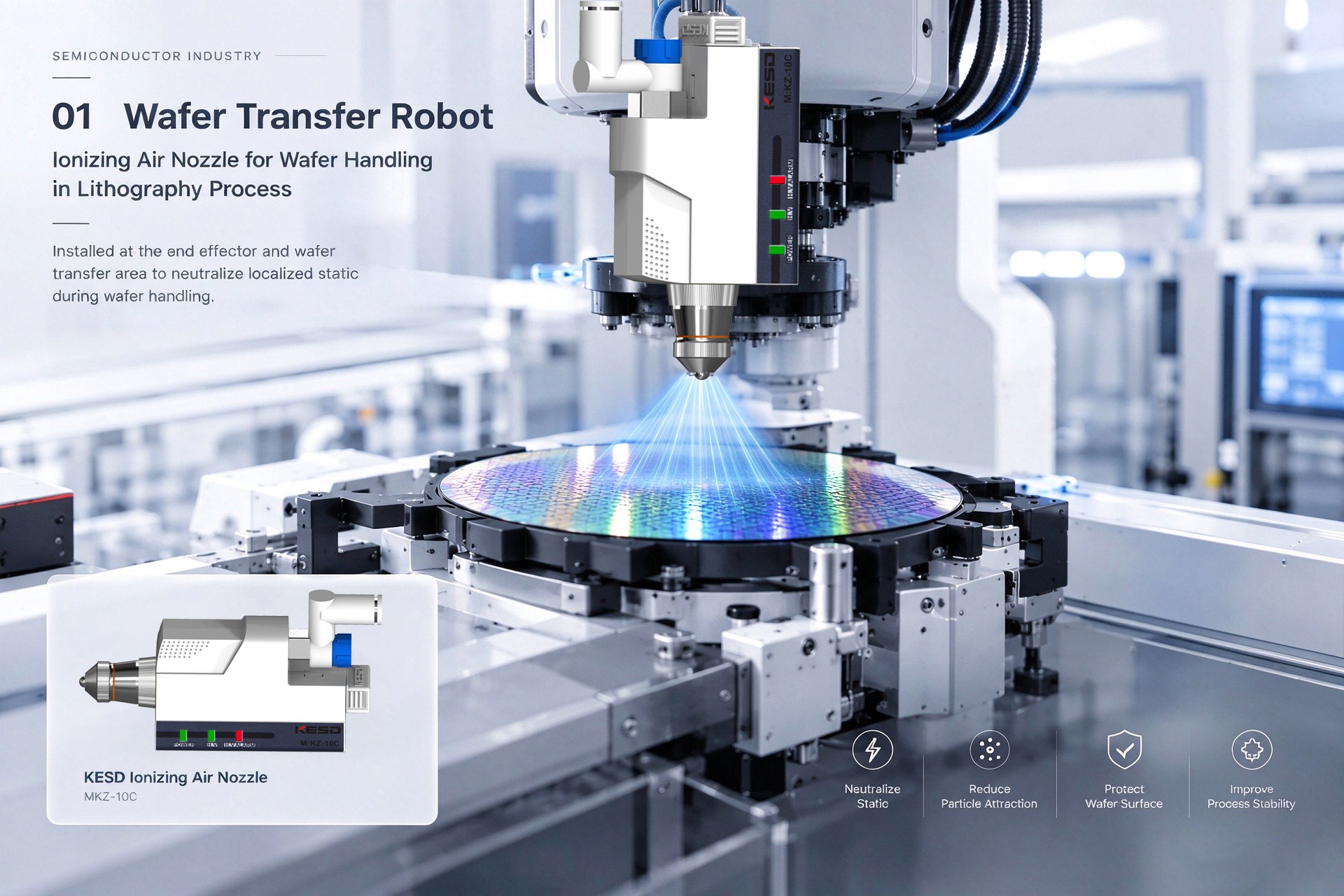


In LCD panel manufacturing, the Array photolithography process requires precise glass substrate handling, accurate positioning, and strict contamination control. Electrostatic charges generated during substrate transfer and robotic handling can attract airborne particles, increase contamination risks, and create challenges for automated production systems.
KESD Ionizing Air Nozzles provide targeted, non-contact static elimination for glass substrates during suitable atmospheric handling and transfer operations before and after photolithography exposure.
By delivering balanced positive and negative ions to localized areas, KESD ionizing air nozzles help neutralize electrostatic charges, reduce electrostatic dust attraction, and support cleaner, more stable LCD Array manufacturing processes.
Photolithography is a critical process in LCD Array manufacturing. Glass substrates pass through multiple precision operations, including photoresist coating, exposure, and subsequent development.
During these processes, substrate cleanliness and handling stability are essential. Electrostatic charges can create several manufacturing challenges:
Charged glass substrates attract airborne particles through electrostatic forces. Particle contamination may affect substrate surface cleanliness and increase the risk of defects in subsequent processing.
Automated handling systems use robotic arms, vacuum grippers, and transfer mechanisms to move large glass substrates. Contact and separation during handling can generate electrostatic charges, potentially causing substrate adhesion and transfer difficulties.
Dust attracted to substrate surfaces may affect subsequent coating, exposure, development, or inspection operations. Effective static control helps reduce electrostatic-related contamination risks.
Uncontrolled static electricity may increase cleaning requirements, handling difficulties, and production interruptions. Maintaining appropriate static levels supports more consistent substrate processing.
Electrostatic charges can accumulate on glass substrates and nearby handling components during automated production.
Common sources include:
Contact and separation: Repeated contact between glass substrates, robotic grippers, carrier surfaces, and handling components can generate electrostatic charges.
Robotic movement: High-speed substrate picking, lifting, transferring, and positioning may contribute to static buildup.
Material interaction: Insulating materials used in grippers, rollers, and transport systems may retain electrostatic charges.
Low-humidity environments: Lower humidity can reduce natural charge dissipation and allow static charges to persist.
In photolithography production, static control is particularly important during atmospheric substrate handling and transfer stages, where electrostatic dust attraction can affect substrate cleanliness.
KESD Ionizing Air Nozzles are designed for localized static elimination in precision manufacturing applications.
The ionizing air nozzle generates positive and negative ions and delivers them through a focused airflow toward the target surface. These ions help neutralize electrostatic charges on glass substrates and other charged surfaces without direct physical contact.
Compared with wide-area static elimination equipment, ionizing air nozzles offer a more targeted approach for specific static-sensitive locations, especially around robotic handling systems and automated transfer stations.
Targeted Static Neutralization
Delivers ions to specific areas where electrostatic charges are generated or accumulated during substrate handling.
Reduced Electrostatic Dust Attraction
Helps reduce the electrostatic forces that attract airborne particles to glass substrate surfaces.
Non-Contact Operation
Neutralizes static charges without touching delicate glass substrates, supporting precision handling requirements.
Compact Equipment Integration
Can be installed near robotic end effectors, substrate transfer mechanisms, and other suitable equipment locations.
Flexible Installation
Air nozzle positioning and airflow direction can be adjusted according to substrate dimensions, robot movement, and equipment layout.
Actual neutralization performance depends on the nozzle model, airflow, operating distance, substrate movement, and environmental conditions.
Before entering the photolithography exposure equipment, glass substrates are transported through atmospheric handling areas.
Static charges generated during storage, transportation, and robotic handling may attract airborne particles to the substrate surface.
Installing a KESD Ionizing Air Nozzle at an appropriate pre-exposure transfer station helps neutralize static charges before the substrate enters the exposure equipment.
This supports cleaner substrate handling and helps reduce electrostatic dust attraction before precision processing.
Robotic systems play an important role in LCD Array photolithography, where glass substrates must be accurately picked up, transferred, and positioned.
An ionizing air nozzle can be installed near a suitable robotic end effector to deliver ions toward the glass substrate during handling.
This targeted installation helps control static charges generated during substrate pickup, separation, and transfer without direct contact with the glass surface.
The nozzle position and airflow direction should be carefully designed to avoid interference with robotic movement, substrate positioning, and cleanroom requirements.
After exposure, glass substrates move through atmospheric unloading and transfer areas before entering subsequent manufacturing processes.
Static charges generated during substrate release and handling may attract particles during downstream transportation.
Installing a KESD Ionizing Air Nozzle at a suitable post-exposure transfer point helps neutralize residual static charges and supports cleaner substrate handling before subsequent processing.
Important: KESD Ionizing Air Nozzles are intended for suitable atmospheric static elimination applications. They should not be assumed to be suitable for direct installation inside vacuum chambers, enclosed exposure systems, or sensitive optical areas without specific equipment and process qualification. Installation locations must be evaluated for cleanroom compatibility, airflow effects, particle control, and process requirements.
KESD provides industrial static elimination solutions for precision electronics manufacturing and automated production environments.
Precision Static Elimination: Targeted ion delivery for localized static control applications.
Compact Design: Suitable for integration into limited installation spaces around automated equipment.
Non-Contact Operation: Helps neutralize static charges without direct contact with glass substrates.
Automation Integration: Can be incorporated into compatible robotic handling and substrate transfer systems.
Flexible Application Solutions: Nozzle selection and installation can be customized according to substrate dimensions, handling speed, airflow requirements, and equipment layout.
KESD can evaluate the specific operating conditions and recommend a suitable ionizing air nozzle configuration for your LCD manufacturing application.
Choosing the right ionizing air nozzle requires consideration of both static-control performance and equipment integration.
Key selection factors include:
Installation location: Robotic end effector, substrate loading station, unloading station, or transfer area.
Substrate dimensions: Determines the target ionization area and nozzle arrangement.
Static voltage: Initial static voltage and required residual voltage help establish performance targets.
Operating distance: The distance between the nozzle and substrate affects ion delivery and neutralization performance.
Air pressure and airflow: Must match the application and avoid disturbing substrate positioning or sensitive processes.
Cleanroom requirements: Materials, particle generation, maintenance, and airflow compatibility must meet the production environment requirements.
Providing these details helps KESD evaluate a suitable static elimination solution for your photolithography production line.
Looking for a reliable ionizing air nozzle for LCD manufacturing?
KESD provides targeted static elimination solutions for LCD Array photolithography applications, including glass substrate loading, robotic handling, and atmospheric transfer operations before and after exposure.
To help us recommend the right ionizing air nozzle, please share:
Glass substrate dimensions
Robotic handling or transfer system details
Current static voltage or static-related problems
Available installation space and operating distance
Required airflow and air pressure
Cleanroom classification and process requirements
Contact KESD today to discuss your LCD photolithography application and find a suitable ionizing air nozzle for precision static control.
By continuing to use the site you agree to our privacy policy Terms and Conditions.